Somebody Told Me
Last year my annual death aligned with the winter season. It struck me right before the end, my little Subaru was out of her head and coughed out her last drops of blood in the cold. She died in Madison, Wisconsin rolled over in the dark chill of a November night. I stayed over at my brother’s apartment, a little sad and dazed about the situation.
Since that evening, I’ve journeyed through a personal renaissance. I took myself as I was, a page out of a children’s bent and uglied coloring book, and simply shaded in the parts that I had ignored essentially all my life. In those filled-in spaces are the colors taken from the people that offered themselves. Those folks along my path that didn’t mind shedding their heart and bleeding for those who needed warmth. I had my parents, my brother and close friends, sweethearts from youth, and guides that had already passed through the mazes I was attempting. And in the crux of my worst fire, with a battle-ready hose and adorned in a fire proximity suit, was Carl Bogner, an instructor and mentor that had dealt in these rescues for decades.
To be a teacher and gardener on the level of Carl doesn’t actually take much in the way of talent and skill, it just requires an intensely beating heart and a deft knack for observation. Humans are of a unique characteristic with their personalities and drives for specialty. It takes the patience inherent in great empathy to see these traits in people that set them apart, and an even greater compassion to hear them and draw out those compacted strengths that allow them to be the greatest artists and humans they can possibly be.
Early on in my conversations with him as a student, I walked past him at a bus stop outside the Student Union and noticed The Plains, a novel authored by Australian great Gerald Murnane, in his hand. I had heard of The Plains recently and ecstatically asked him what he thought. Part of him was puzzled, as I had only a few classes with him in a giant lecture hall and he had yet to learn much about me, that as a University freshman I had a curiosity in the fellow that wrote it. This was our first talk about books, it was short, but from here these small passing moments with books in hand would serve as the inciting sparks to my development as an author and reader.
Carl, although a professor in the Film Department, is deeply attuned to great works of literature. Every class I had with him, he had assigned a novel for us to read throughout the semester. It was a light gesture, perhaps to annoy us with the keen understanding that all forms of art and narrative are strung together in their foundations. I remember most personally reading Just Kids by Patti Smith and feeling a great range of hurt and love. It brought me closer to myself and my art, especially when read in tandem with Carl’s instruction and contagious enthusiasm.
I owned that copy for that class, in a way it was our assigned textbook. I wish I could say I still had it, unfortunately I lent it to a person I matched with on Tinder who stopped texting me after date number three. But that is okay, I think old Carl would be delighted to hear that I gave up such a lovely book so that a stranger in need could reclaim their smile through the joy and heartbreak only a great fucking book could endow.
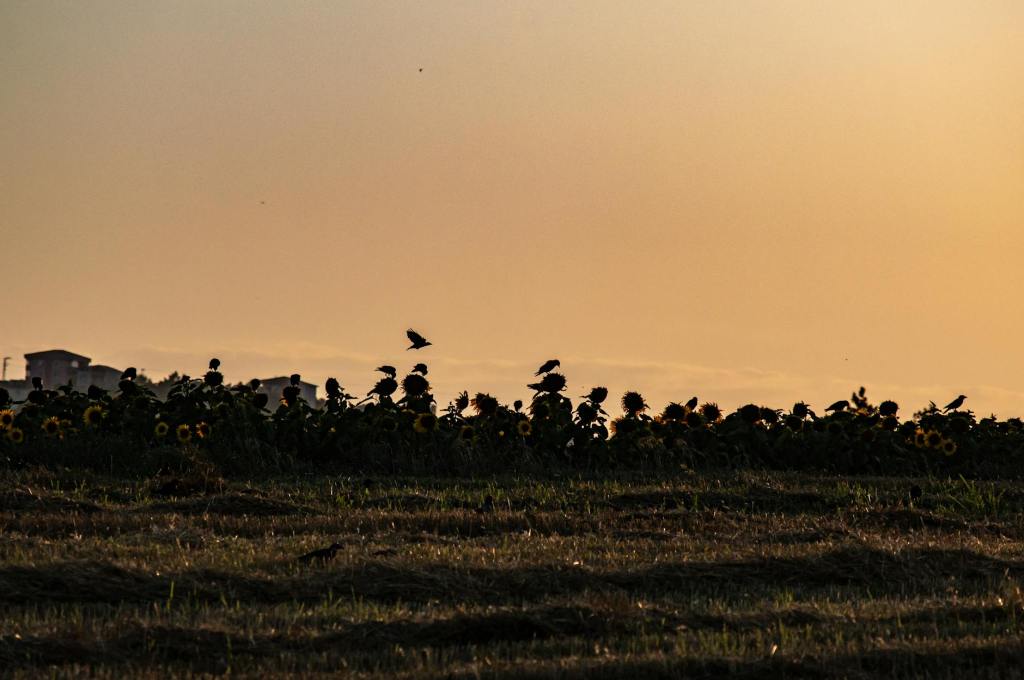
After all, it is the light, almost unthinking gestures such as these that we make in our vanishing seconds which furnish our otherwise vacant brains. Such as, seventy years prior, when Allen Ginsberg had carved about and found himself in San Francisco. He built a poem, off the insistence of his friend Jack Kerouac, titled “Sunflower Sutra” with barely any revision and spoke it to the world from the chaos of his first draft.
Ginsberg, the poet and maker, was one of those peculiar characters that flowered a community of great artistic minds seemingly just by existing. He was of the type that people wanted around them, that great mind that could inspire movements through yip yap and charm. A personality so friendly and well-read, a bleeding heart whose passion and power excites those surrounding him to be their most alive.
Brandishing sunflowers and weeds, they carry themselves into the hills. Once alone, part empty and barren, they heal the trodden soil. Exhausted, naive, bile of the Earth sparked to breathe. Once anchor, then tide, then shining sun.
After I graduated, we followed each other on Instagram. I always had the thought that he still had an interest in what I’d write, where I’d go, and what I’d achieve. But I haven’t heard from him in years. Then, about two years ago, somebody told me.
Carl had been diagnosed with advanced brain cancer at the age of 60. Surviving like a monarch. He’d been through the stages of debilitating radiation and chemotherapy. At the time I had found out, he was reaching the edge of where his own humble means could take him. A GoFundMe was started in hopes to raise enough funds so that he could live comfortably and hopefully fight back against the disease.
Over time, the charity would raise over $170,000 thanks to the efforts of his colleagues, students, friends, but mostly through the efforts of the communities that he ennobled through three decades of passion, heartache, and unending ambition. Though despite all this, every inch of favors returned tenfold and the fervor of love for a teacher whose life itself presented those crucial lessons of living with grace and purpose, there is still a tired hole.
To stand is a difficulty. To move is a difficulty. He is ineligible for medicaid assistance and long-term care insurance. In spite of the years, that canyon of time since I’ve last seen him and wished him well, his presence remains the most vibrant color shaded in who I am today and the man I strive to be every morning when I wake up to the eventual close of night. Yet, there isn’t enough power in my heart alone.
I had a conversation recently with another friend who could echo all that I’ve written, but for the makeup of himself. We went over this situation and recounted the memories of our college years. We were at pains to decipher the moments through the clouded atmosphere in our heads, but one thing remained constant. It was Carl Bogner.
Somebody told me that this is it. That there is hell, there is cruelty, there is strict reality, and stuffed under the surface is us. Under the weight of air, the thing that both pins us to the ground and lets us live, is us. We move about our day, filing through our routines, and occasionally we stop for a laugh. But never have I seen someone break the clock, the rhythm, hold their breath, and smile. I haven’t done it, nor has my friend, and neither have my neighbors that I walk along with everyday. But two years ago, I heard of someone who had.
The last stanza of Allen Ginsberg’s “Sunflower Sutra” begins with this: We’re not our skin of grime, we’re not our dread bleak dusty imageless locomotives, we’re all golden sunflowers inside…
Carl’s GoFundMe is still live, I encourage and hope you donate what you can: https://gofund.me/299a8ef0

 The Benjamin Report
Leave a comment